Cercar en aquest blog

Compte enrere

10 d’abr. 2013

Catalan independence? Not everyone shares the same point of view

Here are three examples of different points of view as regards Catalonia's quest to regain independence from Spain. Comments made to a April 2013 text by Matthew Parris.

Click here, if need be, to read the whole post

18 de març 2013

Garbo, the Catalan who misled the Germans on D Day!

Joan Pujol-Garcia MBE (1914-1988) fought on the Allies' side as "Garbo" during the Second World War. He won the confidence of the Nazis, tricking them into thinking he was he was an antisionist on their side willing to spy for them.  However, in actual fact he began to send them false messages, in accordance with the British authorities, and the moment of truth came when he led them to believe that the main thrust of the Allied liberation of Europe would aim at Calais and not at the Normandy beaches, which the Germans were led to believe was a decoy to distract their forces away from the narrowest part of the Enlgish channel.
Four years before his death, Joan Pujol was interviewed by Josep Maria Espinàs in "Identitats", on September 14 1984. Here is the fascinating hour-long programme.


Link: http://www.tv3.cat/3alacarta/#/videos/2412859

More information: http://en.wikipedia.org/wiki/Joan_Pujol_Garcia

13 de març 2013

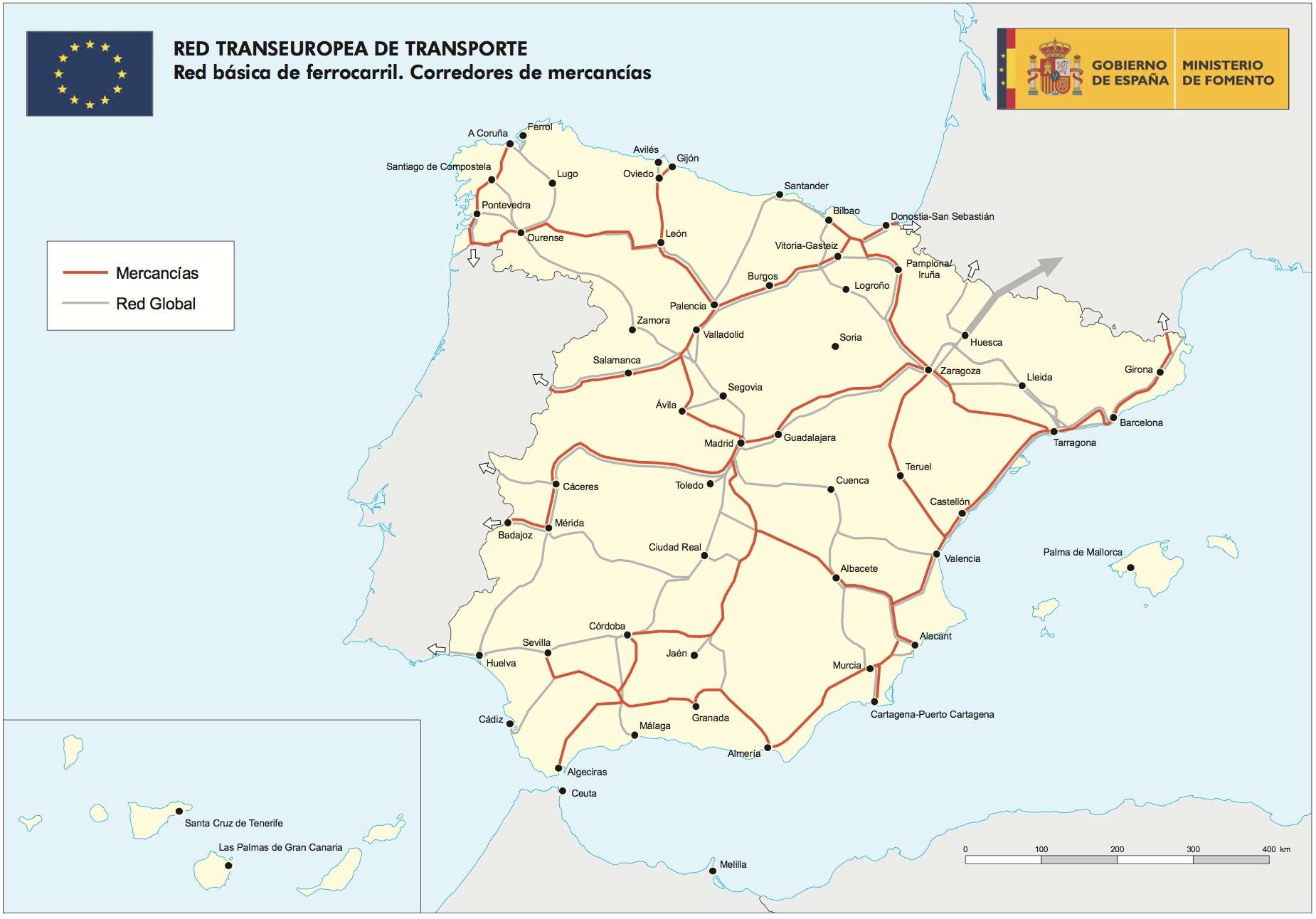
TEN-T. Rail freight corridors planned by Spain and accepted by the European Union.

REGULATION (EU) No 913/2010 OF THE EUROPEAN PARLIAMENT AND OF THE COUNCIL
of 22 September 2010 concerning a European rail network for competitive freight defines nine "initial freight corridors", of which number 6 is "Almería - Valencia/Madrid - Zaragoza/Barcelona - Marseille - Lyon - Turin - Milan - Verona - Padua/Venice - Trieste/Koper - Ljubljana  - Budapest - Zahony (Hungarian-Ukrainian border)". It is due to be functional by 10 November of this year (2013).

Within Spain the apparent confusion caused by the obliques strokes is clarified, to some extent, in a footnote:
"‘/’ means alternative routes. In line with the TEN-T priority projects, routes 4 and 6 should in the future be completed by Project 16, the Sines/Algeciras-Madrid-Paris freight axis which takes in the central Pyrenees crossing via a low elevation tunnel."


This map,  shows the (planned) main routes from the Iberian peninsula into western Europe and helps to clear the confusion. There are others you can refer to here.

"Almería - Valencia/Madrid - Zaragoza/Barcelona - Marseille" presumably means that the plan includes two European gauge rail freight corridors: 

a. Almería - Madrid - Zaragoza - Marseille...
b. Almería - Valencia - Barcelona - Marseille...

The latter is the "Mediterranean corridor", long-demanded by all the Mediteranean ports, whose geostrategic position would allow them (and thus the peninsula as a whole) to compete with the ports of northern Europe (Antwerp, Hamburg, Tilbury...) for the lucrative Middle and Far Eastern trade market.

The oblique strokes would seemingly not make clear how the Zaragoza - Marseille connection is to be made. A quick look at the map of "initial freight corridors" suggests that the Barcelona route makes economic sense, without the need for investments beyond.

However,  the map certainly does not clarify the Almería - Madrid route: one stretch of the track is not marked for freight.

Moreover, the footnote says that "routes 4 and 6 should in the future be completed by Project 16, the Sines/Algeciras-Madrid-Paris freight axis which takes in the central Pyrenees crossing via a low elevation tunnel". What is Route 4? Route 4 starts in Sines (Portugal) and takes two routes, - Lisbon/Leixões and - Elvas/Algeciras before linking up, on both routes, to Madrid - Medina del Campo/Bilbao/San Sebastian - Irun - Bordeaux - Paris/Le Havre/Metz.


What is Priority Project 16", then? It seems to be a longer term project, one of "30 Priority Projects (or axes)... identified on the basis of proposals from the Member States and are included in the Union guidelines for the development of the TEN-T as projects of European interest" (source)

This is the map of the enigmatic "Priority Project 16: Freight railway axis Sines/Algeciras-Madrid-Paris", not included as one of the "initial freight corridors" in the 2010 Regulation.

As far as one can see, this is basically the initial freight corridor No. 4, up to Madrid. And from Saragossa northwards, we again find that enigmatic route through the Central Pyrenees, marked as a grey line in the top map, and here in a strange arrow shape.

The Executive Agency's 2011 Progress Report on on-going projects (the most recent I have found) consists of a map, of which I have just taken the following: 

Yet again, there is an enigmatic, but well drawn arrow shape or through across the central Pyrtenees. Moreover, the pink dot in the middle means that there is (or was) an on-going project in that area. WEhat is it? Well ,the previous map gave its reference number, which corresponds to "Freight Railway Axis Sines-Madrid-Paris: New high capacity line through the Pyrenees". We are informed on the Agency website that 

"At a high level inter-governmental conference in Zaragoza, Spain in June 2008, France and Spain committed to launch the necessary studies for the construction of this new line through the creation of a European Economic Interest Group (EEIG).

This project specifically consists of the preparation of the following studies as:

  • Preliminary technical, economic and financial studies, including an analysis of the possible locations of the corridor in France and Spain
  • Environmental studies
  • Studies necessary to launch the public consultations in Spain and the public debate in France"

  The Agency website tells us that "The project also includes the construction of a long distance tunnel through the Pyrenees, in order to eventually link it with the branch of the Grand Projet du Sud-Ouest [GPSO] towards Toulouse." However, the GPSO website speaks nowhere at all of any tunnel through the Pyrenees. Instead it says that "Le Grand Projet ferroviaire du Sud-Ouest fait partie du projet global LGV Sud Europe Atlantique (LGV SEA) défini, depuis la déclaration d'intention du 25 janvier 2007, comme un ensemble cohérent composé de trois branches : Tours-Bordeaux, Bordeaux-Toulouse et Bordeaux-Espagne, auquel a été ajoutée la branche Poitiers-Limoges."


Returning to the Agency website, we read that Priority Project 6 is the "Railway axis Lyon-Trieste-Divača/Koper-Divača-Ljubljana-Budapest-Ukrainian border" does not start in Almería or even in Spain: it takes off in Lyon.

 The confusion grows when we read yesterday that 

"Pastor firma en Bruselas un acuerdo que impulsará el transporte ferroviario de mercancías por el Corredor Mediterráneo


Con los responsables de transportes de Francia, Italia, Eslovenia y Hungría.
  • El acuerdo establece la Comisión Ejecutiva del Corredor Ferroviario de Mercancías nº6, que se extenderá desde Almería hasta Zahony (Hungría)."
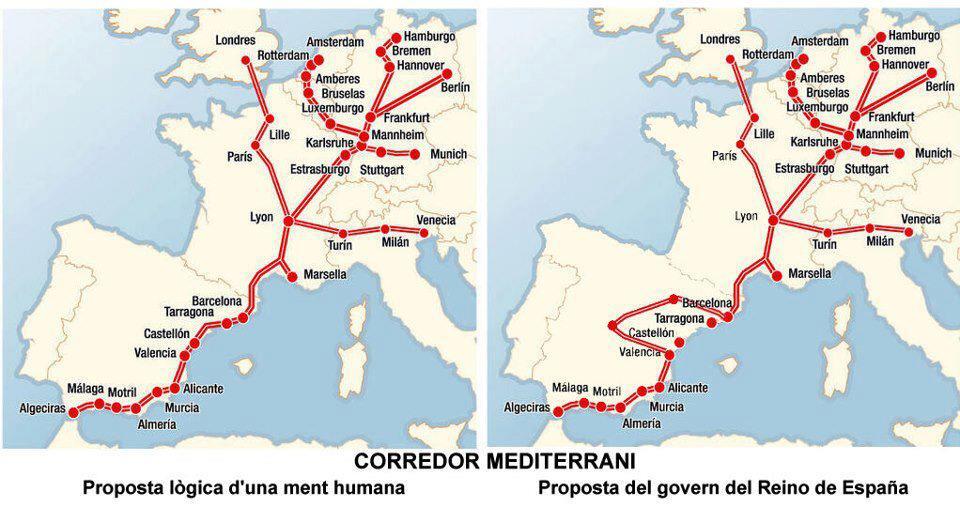
Today twitter is full of odd maps (like the one on the right, below) and many Catalans feel that the "Mediteranean" corridor Minister Pastor speaks of will in fact go through Madrid! A public clarification is in order!


4 de març 2013

The Treaty of Utrecht (1713) and the Siege of Barcelona (1713-1714)

Article 13 reads:

"Whereas the Queen of Great Britain has continually pressed and insisted with the greatest Earnestness, that all the Inhabitants of the Principality of Catalonia, of whatever State or Condition they may be, should not only obtain a full and perpetual Oblivion of all that was done in the late War, and enjoy the entire possession of all their Estates and Honours; but should also have their ancient Privileges preserved safe and untouched; the Katholic King, in compliance with the said Queen of Great Britain, hereby grats and confirms to all the Inhabitants of Catalonia whatsoever, not only the Amnesty desired, together with the full Possession of all their Estates and Honours; but also gives and grants to them, all the Privileges which the inhabitants of both Castiles, who of all the Spaniards are the most dear to the Catholick King, have and enjoy, or may hereafter have and enjoy".

This text was signed in Utrecht on July 13 1713. (source)

King Philip V of Spain (IV of Aragon) laid siege to the city of Barcelona on July 25 1713: twelve days later. The siege was to last 13 months, and ended with the fall of the city to the Spanish and French troops.

Britain's signature in the Treaty of Utrecht broke with its commitments in the earlier, secret Treaty of Genoa, signed between England (represented by Mr. Mitford Crow) and Catalonia ( represented by Antoni Peguera i Aymerich and Dr. Domènec Perera) in 1705. A Spanish version can be read here (pp. 43-47 of the book, pp. 99-103 of the PDF file). A Catalan translation is available here.

12 de nov. 2012

Papers from the 5th EUNoM Symposium / Ponències del 5è Simposi EUNoM 14-15/5/2012


TIC, aprenentatge virtual i llengües. Vídeos i resums del V Simposi de la xarxa Eunom (2012).
Si cal, clica a sota, a "Més informació", per accedir a tota l'entrada

26 d’oct. 2012

Catalonia in the news lately!


23/10/2012 [FR]

http://www.eurotopics.net/fr/home/presseschau/archiv/results/archiv_article/ARTICLE113104-L-Europe-favorise-les-separatismes

L'Europe favorise les séparatismes

Les mouvements séparatistes en Espagne, Belgique et Grande-Bretagne ont des origines différentes, mais ils ont tous étés favorisés par l'intégration européenne, analyse le quotidien libéral NRC Handelsblad....


27/9/2012 [NL]
http://www.nrc.nl/nieuws/2012/09/27/catalonie-wil-referendum-over-zelfbeschikking-houden/

Catalonië wil referendum over zelfbeschikking houden

catalonia
Catalaanse demonstranten bij een protest in Barcelona deze week. Foto Reuters / Gustau Nacarin
BUITENLAND 
Het regionale parlement van Catalonië heeft ingestemd met een referendum over zelfbeschikking van de regio. De Spaanse regering heeft al gezegd een dergelijke volksraadpleging door het hoogste Spaanse hof tegen te zullen laten houden. Dat meldt persbureau AP. [MORE]
.

30 de set. 2012

Video in English on Catalonia's fiscal arrangements with Spain

Participants:


  • Prof. Clara Ponsatí (Director of the Institute for Economic Analysis; Barcelona Graduate School of Economics)
  • Prof. Montserrat Guibernau (Professor of Politics at Queen Mary College University of London)
  • Dr. Joan B. Casas (Dean of Catalan College of Economists; Managing partner of Faura-Casas Auditors-Consultors S.L.) 
  • Dr. Heribert Padrol (Head of the TaxArea Corps of State Finance Inspectorate)
  • Prof. Núria Bosch (Professor of Economics at the University of Barcelona; Researcher at Barcelona Economics Institute)
  • Dr. Elisenda Paluzie (Researcher at the Centre for the Economic Analysis of Social Policies; Dean of the Faculty of Economics and Business of the University of Barcelona)
  • Prof. Jordi Galí (Director of the Centre for Research in International Economics)
  • Prof. Carles Boix (Robbert Garret Professor of Politics & Public Affairs at Princeton University
  • Prof. Guillem López Casasnovas (Professor of Applied Economics at Pompeu Fabra University 
  • Prof. Andreu Mas-Colell (Minister of Economy and Knowledge, Gvoernment of Catalonia; Professor of Economics at Pompeu Fabra University; former Professor of Economics at Harvard University (1981-1996) 
Click to watch video Video in English (2m 54s)

More information: http://www.stopespoli.cat 

More information on Catalonia-Spain relations: see "Spain's Secret Conflicthttp://miquelstrubell.blogspot.com/2011/06/spains-secret-conflict-video-39-min-45.html

26 de set. 2012

Relations between Catalonia and Spain: "Make them give back what they took away"

The latest entry by the last President of Extremadura, Guillermo Fernández Vara is titled "Give back what you took away!"

Que devuelvan lo que se llevaron

Sé que no es hora de salidas de pata de banco. Ni de regates en corto. Pero las palabras hoy del Presidente de la Generalitat, sus decisiones y las consecuencias de las mismas, no me permiten cruzarme de brazos, nos nos permiten cruzarnos de brazos. Mañana tendré la oportunidad de valorar en rueda de prensa la situación, pero quiero decir algo que no admite demoras. No sé que pasará, creo que ni el lo sabe, y bien grave que es someter en plena crisis a Cataluña y al resto de España, a unas elecciones con un programa electoral basado en la independencia, y no en el empleo, las empresas, la educación o la sanidad. Pero si algún día logrará su objetivo, el President debería devolver antes lo que se llevaron hace ahora treinta o cuarenta años. No me refiero a riquezas materiales sino a seres humanos. 150.000 personas que nos fueros sustraidas, más sus hijos y sus nietos. No digo más. Nacieron en España, en una parte de la misma llamada Extremadura, que no les podía dar de comer porque alguien así lo decidió. Y se fueron a otra parte de España, Cataluña, porque el mismo así lo decidió. Llegado el momento, por favor que antes nos los devuelvan.
Guillermo
http://www.elcuadernodeguillermo.com/?p=180057&cpage=1#comment-9000

"Make them give back what they took away"

I know it's not the time for to bench leg outputs. Or for short dribbles. But today the words of the President of the Generalitat, his choices and the consequences thereof, will not let me sit back with folded arms, won't let us sit back with folded arms. Tomorrow I will have the opportunity to assess the situation in a press conference, but I mean to say something that can't wait. I do not know what will happen, and I don't think even he knows, and it is quite serious in the throes of this crisis, to subject in Catalonia and the rest of Spain, to an election with a manifesto based on independence, and not on employment, business, education or health. But if someday he were to achieve his objective, the President should first return what they took away thirty or forty years. I do not mean material wealth but human beings. 150,000 people were taken from us, and their children and grandchildren. I've said enough. They were born in Spain, in a part of it called Extremadura, that could not feed them because someone decided. And they went to another part of Spain, Catalonia, because that same person decided. If and when the time comes, please return them to us beforehand.

Note: Extremadura-born Catalan residents:
1981 184,592
1991 171,597
2001 152,097


1 d’ag. 2012

Current Affairs in Catalonia (August 2012) Part 1

We recommend an article entitled "El Setge" ("The Siege") by La Vanguardia columnist Jordi Graupera. It was published on July 28th. This article should not be confused with the one written by Manel Cuyàs, with the same title, published in El Punt Avui on April 15th 2012: http://www.elpuntavui.cat/noticia/article/7-vista/8-articles/528207.html (see my English translation here: http://miquelstrubell.blogspot.com/2012/04/siege.html)

http://epaper.lavanguardia.com/epaper/mobile/articleview.aspx?bookmarkid=FDYH5JLG8QF7 

El setge (The Siege)

Jordi Graupera

(our translation)

The immediate reactions of the Spanish parties to the fiscal pact adopted by the Catalan Parliament last Wednesday coul lead one to think that a period of political confrontation between Catalan and Spanish institution is about to begin. However, the truth is quite another: the conflict broke out some time ago and the Government in Madrid has been working for months on the basis of the most radical hypothesis, taking for granted that the "uncharted territory” that CiU says we are entering is a secessionist operation.

The most graphic way of describing the Spanish Government's maneouvres is to talk about the Catalan civil servants' payroll. The State – that claims to have guaranteed cashflow until December –, instead of paying the money it is bound to do, as a lump sum for Catalan minister Mas-Colell to administer, makes monthly payments, with which the Generalitat (Catalan Goveernment) pays the payroll. But these are not made on 25th, as would be logical were minister Montoro to have the intention of negotiating something, or of “cooperating”, as he puts it. He makes the payments on the 31st, at 11.30 pm.

If you want to talk to the top officials in the President's Office or the Catalan Minitry of Economy, I recommend that you phone at the end of the month, late at night: you'll be sure to find them, they're always there, just in case the cash doesn't arrive. That's if they're lucky. Last month it didn't, and the money wouldn't have arrived in time; the Catalan minister warned that the Government might default – in which case complete political intervention would have ensued –, and Cristóbal Montoro said fine, it's your problem, you solve it. A short-term loan from a Catalan bank allowed the month to be saved. And this month the payroll will be met by the annual tax on fortunes - a feature of the Catalan tax system –, but I've seen mayors rushing because they won't have enough money to pay for services they have contracted. Next month, noone knows yet.

This situation means that the Government lives drowned by urgency, rushing to and fro putting out fires. We have a full Harvard professor acting as accountant and a whole political generation buried by bureaucracy. Moreover, any audacious moviment by our political representatives is immediatately neutralised by the civil servants' payroll. Any default would mean that 250,000 people's salary would not be paid, and that the domino effect would shatter everything. And put any end to self-government. And this is just one example. There are plenty more: yes, the siege has begun.

The only relevant question, then, is whether the Catalan Government is doing anything so as not to have to rely so drastically upon the Madrid agenda, which consists of empoverishing the Catalan Government (Generalitat), firstly to have it under its control, and then without any maneouvring leeway to dig in its heels and negotiate. A social explosion in Barcelona would be perfect for centralizing once and for all, with the assent of the world, and the only way out for Artur Mas is to appeal to the people, through any early election, and on a clearly pro-independence ticket. Time, however, is on Madrid's side: for every month he has less room in which to manoeuvre.


See previous current affairs postings on this weblog: http://estudiscatalans.blogspot.com/2012/06/current-affairs-in-catalonia.html

23 de jul. 2012

"As Spain Protests Austerity, Catalonia Pushes for Independence"


Posted July 20, 2012 by Nicholas S. Siegelthe Program Officer at the Transatlantic Academy, where he helps design and implement Academy research activities and outreach strategies. His research focuses on the US-EU.

The Transatlantic Academy is a research institution devoted to creating common approaches to the long-term challenges facing Europe and North America. The Academy does this by each year bringing together scholars, policy experts, and authors from both sides of the Atlantic and from different disciplinary perspectives (click here to read more)

17 de jul. 2012

Twitter conflict

Just like any other environment where people of all sorts meet and jostle together, Twitter allows us all to let us off steam!

The fact that some people in Spain view Catalan and Catalans critically is easy to observe and study.

The development and publication on July 8th of a Catalan-language interface for PC access to http://www.twitter.com/ gave rise to reactions of all kinds. On July 12 Global Voices printed a report by Violeta Camarasa, with juicy comments translated into English.

#twitterencatala provokes tweets of joy and hate

A website that records anti-Catalan tweets, in Spanish, is http://apuntem.cat/

A Catalan MEP, Ramon Tremosa, has complained to the European Commission about these anti-Catalan ethnic tweets, which have not been as yet percecuted by the authorities. There are precedents in other countries. UK Student Liam Stacey was sentenced to 56 days in prison in March 2012 for posting offensive comments on Twitter after footballer Fabrice Muamba had a cardiac arrest during a match:

13 de jul. 2012

The Catalan Footprint in Australia / L'Empremta Catalana a Austràlia

http://www.catalanfootprintinaustralia.net/scr/1/index_en.php


..."From that day, I met more than 30 people from Catalan descent in Queensland, New South Wales, Victoria, the Northern Territory and Western Australia. They kindly opened their doors and unveiled their family secrets. I am enormously grateful to every single one of them for sharing such treasures with the rest of the world." Lluïsa Vilalta, project director ...


Caga tió in Queensland

Margaret, Peter, Teresa Tapiolas, Dianne, Bruno Tapiolas, Louise, Stephen, Terese, Grant, Mary Anne and Ines kick the log with a stick every Christmas to preserve the Catalan tradition. (Photo: 1961)


21 de juny 2012

Catalan in Aragon

1996
Organic Law 5/1996, Reforming the Statute of Autonomy of Aragon, in Article 7, states that: 

Las lenguas y modalidades lingüísticas propias de Aragón disfrutarán de protección. Se garantizará su enseñanza y el derecho de los hablantes en la forma que establezca una Ley de las Cortes de Aragón para las zonas de utilización predominante de aquellas

Aragon's own languages and linguistic varieties shall enjoy protection. Their teaching, and the right of speakers, will be guaranteed iunder the terms laid down in an Act of the Parliament of Aragon, for the areas where their use is predominant. 

2005
On 21 September 2005 the Council of Europe issued its Report - ECRML (2005) 4 - in the initial monitoring cycle, on the application of the European Charter for Regional or Minority Languages in Spain. It included the Recommendation orf the Committee of Ministers.  

The Committee of Ministers recommended "that the authorities of Spain take account of all the observations of the Committee of Experts and, as a matter of priority ... "6. strengthen the protection of Aragonese ("Fabla") and Catalan in Aragon, inclduding establishing an appropriate legal framework" (page 167).

The Spanish Ministry for Foreign Affairs made the following remark in paragraph R (page 165): "The government of the Autonomous Community of Aragon has already carried out the necessary prior studies for the forthcoming regulation in a single Act of the different languages spoken in its territory. The great difference between Catalan, a socially well-established language with a solid literary tradition, and Aragonese Fabla, with a very limited number of speakers and limited standardisation and literary use, undoubtedly explain why this bill has not yet been passed."

2007


1. Las lenguas y modalidades lingüísticas propias de Aragón constituyen una de las manifestaciones más destacadas del patrimonio histórico y cultural aragonés y un valor social de respeto, convivencia y entendimiento.
2. Una ley de Cortes de Aragón establecerá las zonas de uso predominante de las lenguas y modalidades propias de Aragón, regulará el régimen jurídico, los derechos de utilización de los hablantes de esos territorios, promoverá la protección, recuperación, enseñanza, promoción y difusión del patrimonio lingüístico de Aragón, y favorecerá, en las zonas de utilización predominante, el uso de las lenguas propias en las relaciones de los ciudadanos con las Administraciones Públicas aragonesas.
3. Nadie podrá ser discriminado por razón de la lengua.»

1. Aragon's own languages and linguistic varieties are one of the most outstanding manifestations of Aragon's historica and cultural heritage and a social value of respect, coexistence and understanding. 
2. An Act of the Parliament of Aragon will lay down the areas of predominant use of Aragon's own languages and linguistic varieties, will regulate their legal status, the right of the speakers to use them in these areas,  will promote the protection, recovery, teachging, promotion and dissemination of Aragon's linguistic heritage, and will encourage, in the areas where their use is predominant, the use of Aragon's own language in citizens' dealing with Aragon's public authorities.
3. No-one shall be discriminated against on the grounds of language.


2008
On December 11 2008 the Council of Europe issued its Report in the 2nd monitoring cycle - ECRML (2008) 5 - on the application of the European Charter for Regional or Minority Languages in Spain. It included the Recommendation orf the Committee of Ministers 

The Committee of Experts stated, in paragraph P (page 141) that "Regarding Aragonese and Catalan in Aragon, the language law has still not yet been adopted. The lack of a legal framework and of practical measures hampers the promotion and protection of Aragonese and Catalan in Aragon. The Committee of Experts notes however, that efforts are being carried out in the field of education."

The Committee of Ministers recommended "that the authorities of Spain take account of all the observations of the Committee of Experts and, as a matter of priority ... ... "5. take steps to adopt a specific legal framework for protecting Aragonese and Catalan in Aragon"... (page 151).


2009
Law 10/2009, of 22 December, on the Use, Protection and Promotion of Aragon's Own Languages.  Among other things, it lays down the following:


Artículo 2.-Las lenguas propias de Aragón.
  1. El castellano es la lengua oficial en Aragón. Todos los aragoneses tienen el deber de conocerla y el derecho a usarla.
  2. El aragonés y el catalán son lenguas propias originales e históricas de nuestra Comunidad Autónoma.
  3. En calidad de tales, gozarán de protección y se garantizarán y favorecerán su enseñanza y el derecho de los hablantes a su uso en las zonas de utilización histórica predominante de las mismas, especialmente en relación con las Administraciones Públicas.
  4. El procedimiento para declarar los municipios que constituyen las zonas de utilización histórica predominante de las lenguas propias se determina en el artículo 9 de la presente Ley, de acuerdo con criterios sociolingüísticos e históricos.
Artículo 3.-Denominación de modalidades lingüísticas.
Los ayuntamientos de las zonas de utilización histórica predominante de las lenguas propias de Aragón podrán, mediante acuerdo adoptado con el voto favorable de la mayoría absoluta del Pleno, proponer al Consejo Superior de las Lenguas de Aragón la denominación de su modalidad lingüística, fundamentada en razones históricas, filológicas y sociolingüísticas.
Artículo 4.-Derechos lingüísticos.
1. Se reconocen a los ciudadanos y ciudadanas de Aragón los siguientes derechos lingüísticos en los supuestos establecidos por la presente Ley:
   a) Conocer las lenguas propias de Aragón.
   b) Usar oralmente y por escrito las lenguas propias de Aragón tanto en las relaciones privadas como en las relaciones con las Administraciones Públicas.
   c) Recibir la enseñanza de las lenguas propias de Aragón.
   d) Recibir, en las lenguas propias de Aragón, publicaciones y programaciones de radio, televisión y otros medios de comunicación social.
   e) Usar las lenguas propias en la vida económica y social.
2. Nadie podrá ser discriminado por razón de la lengua.
3. Los poderes públicos aragoneses garantizarán el ejercicio de estos derechos, a fin de que sean efectivos y reales.

Section 2.-The languages ​​of Aragon.
1. Castilian is the official language of Aragon. All Aragonese have the duty to know and the right to use it.
2. The Aragonese and Catalan languages ​​themselves are the autonomous community's own, original and historical languages.
3. As such, their protection and teaching, and the right of speakers to use them in areas where their use is historically predominant, especially in relation to public authorities, shall be ensured and encouraged.
4. The procedure for declaring the municipalities in the areas of the predominant historical use of these languages is laid down in Article 9 of this Act, in accordance with sociolinguistic and historical criteria.
Section 3.-Designation of linguistic varieties.
The local councils iin the areas of the predominant historical use of the languages ​​of Aragon may, by the adoption of an agreement by the affirmative vote of a majority in the plenary, propose to the High Council for Languages ​​of Aragon the name of their own linguistic variety, based on historical, philological and sociolinguistic reasons.
Section 4.-Language rights.
1. The following language rights are accorded to citizens of Aragon in the terms laid down in this Act:
   a) To learn Aragon's own languages.
   b) To use Aragon's own languages orally and in writing, both in private relations and in dealings with the public authorities.
   c) To be taught Aragon's own languages.
   d) To receive, in Aragon's own languages, publications and radio, television and other media programmes.
   e) To use Aragon's own languages ​​in economic and social life.
2. No-one shall be discriminated against on the grounds of language.
3. The Aragonese government shall guarantee the exercise of these rights, so that they are effective and real.

2011
Partido Popular election manifesto, "Centrados en ti. El cambio necesario en Aragón". Paragraph 498 (Page 99): 

Derogaremos la Ley de Lenguas,  comenzando al mismo tiempo una política activa para la preservación y divulgación de nuestras modalidades ligüísticas (sic).

We shall repeal the Language Act, starting at the same time an active policy for the preservation and dissemination of our linguistic varieties.

2012 (18 June)
Draft bill on Languages: (Agència catalana de Notícies)

El govern d'Aragó ha presentat l'esborrany de l'avantprojecte de llei d'ús, protecció i promoció de les llengües pròpies de la comunitat, amb què vol derogar tots els aspectes de l'actual Llei de llengües que segons el PP "imposen" la normalització de l'aragonès i el català en aquesta comunitat. L'esborrany deixa de banda la denominació de català i parla d'"aragonès oriental" per referir-se a la llengua parlada a la Franja de Ponent i fixa l'aprenentatge d'aquesta llengua com a "voluntari". Amb aquest canvi legislatiu, el govern d'Aragó vol evitar que la regulació de les llengües de la comunitat es faci a través d'organismes de fora d'Aragó. També preveu la creació d'una única acadèmia de la llengua. 

The government of Aragon has presented the draft Bill on the use, protection and promotion of the community's own languages, with which it wants to repeal all aspects of the current Languages Act which, ​​according to the PP, "impose" the normalization of Aragonese and Catalan in this community. The draft leaves out the name of Catalan and speaks of "Eastern Aragonese" to refer to the language spoken in the "Franja de ponent",  and lays down that the learning of the language will be "voluntary." With this legislative change, the government of Aragon wants to avoid the language being regulated by bodies outside Aragon. It also foresees the creation of a single language academy.

2012 (20 June)
Declaration on the draft Bill by the Institute of Catalan Studies (in Catalan). 

2012 (26 June)


Manifest de la Universitat de Saragossa (Zaragoza University Manifesto)
El catalán pervive en Aragón
Los profesores del área de Filología Catalana de la Universidad de Zaragoza, María Rosa Fort, Javier Giralt, María Teresa Moret, ante la presentación pública del Anteproyecto de Ley de uso, protección y promoción de las lenguas y modalidades lingüísticas propias de Aragón y la preocupación por su futura aplicación, manifiestan que:
1. La comunidad científica reconoce el catalán como lengua hablada en la Franja de Aragón (que abarca zonas de las comarcas de La Ribagorza, La Litera, Bajo Cinca, Bajo Aragón-Caspe, Matarraña y Bajo Aragón), la misma que se utiliza en el Principado de Andorra, en Cataluña, en la Comunidad Valenciana, en las Islas Baleares, en el Carxe, en Alguer (Italia) y en el Rosellón (Francia).
2. El catalán forma parte del patrimonio lingüístico y cultural de la Comunidad Autónoma de Aragón.
3. Las investigaciones que se han realizado hasta ahora en la Universidad de Zaragoza sobre el catalán en Aragón, ratifican que en la Franja de Aragón se habló y se habla catalán.
4. Es ilógico pretender legislar sobre una lengua sin nombre, que se presenta en el Anteproyecto de Ley con el circunloquio “lengua aragonesa hablada en el área oriental de la Comunidad Autónoma”.
5. Lamentan profundamente que el Gobierno de Aragón no dé crédito alguno al trabajo serio y riguroso desarrollado por los profesores del área de Filología Catalana de la Universidad de Zaragoza, quienes, además, siempre han colaborado y asesorado en materia lingüística a las instituciones autonómicas, comarcales y locales que así se lo han requerido.
6. Con esta nueva ley, el catalán carece del reconocimiento mínimamente exigible para su protección, promoción y difusión, y que su enseñanza es la única medida inmediata para asegurar su normalización.

Zaragoza, 26 de junio de 2012


**********

Querido/a amigo/a:
Una parte importante de nuestro patrimonio inmaterial lo constituyen las lenguas. En Aragón, además del castellano tenemos una gran riqueza lingüística que es imprescindible conservar. Para ello es necesario que exista una legislación que las proteja y que respete la normativa internacional en la materia.
En los últimos días hemos conocido la intención del gobierno de derogar la Ley 10/2009 de uso, protección y promoción de las lenguas propias de Aragón sustituyéndola por otra que les niega incluso su propia denominación.
Desde el Rolde de Estudios Aragoneses creemos que la comunidad científica, vanguardia intelectual de la sociedad, debe posicionarse y mostrar su apoyo al reconocimiento expreso del aragonés y el catalán hablado en Aragón, así como de los derechos de sus hablantes, para un desarrollo público normal de ambas lenguas, en aplicación de la legalidad internacional en esta materia y en igualdad de condiciones con el resto de las lenguas de España, Europa y el mundo.
Te pedimos, pues, que apoyes con tu firma el manifiesto adjunto (puedes verlo también en un enlace en la página de inicio de http://www.roldedeestudiosaragoneses.org, donde está traducido a varias lenguas), enviando un correo a haciendo constar tu nombre y dos apellidos, departamento o materia y Universidad o Centro y, si es posible y lo consideras oportuno, hagas llegar esta iniciativa a otros colegas para que también lo refrenden.

Muchas gracias por tu colaboración.

Antonio Pérez Lasheras / Departamento de Filología Española, Universidad de Zaragoza / Junta Directiva de Rolde de Estudios Aragoneses
Rolde de Estudios Aragoneses
Asociación Cultural Declarada de Utilidad Pública (O.M. 29-07-97)
Entidad Declarada de Interés Público Municipal por el Ayuntamiento de Zaragoza
Moncasi, 4, enlo. izda. 50006 Zaragoza
Tfno. y Fax 976 372 250
coordinacion@roldedeestudiosaragoneses.org manifiestolenguas@roldedeestudiosaragoneses.org
www.roldedeestudiosaragoneses.org


2012 (29 June)

EL CONSEJO ESCOLAR TUMBA LA NUEVA LEY DE LENGUAS DEL GOBIERNO

(Aragon's Schools Council turns down the Government's new Languages Bill)


2012 (4 July)

"Menospreciar a la universidad" (Disparaging the university)
José Luis Aliaga Jiménez, profesor de la Universidad de Zaragoza
http://www.lafranja.net/wp-content/uploads/2012/07/Heraldo-de-Arag%C3%B3n.pdf

Quick translation

"The draft of the new Languages Act has already generated a wide range of reactions that will surely crescendo during it parliamentary process. Here I want to highlight just one of the most harmful aspects of the draft bill: the humiliating contempt to which the University of Zaragoza is subjected, and what is worse, the text comes with the endorsement of two qualified members of Aragon's leading academic institution, the Minister of Education and University Dolores Serrat, and the Director General of Cultural Heritage, Javier Callizo.
Unlike the law in force (2009), the new version  drops  any explicit reference to the University of Zaragoza in its consultative status or even, and this is unheard of, as a key agency in research on, and building knowledge of, the languages ​​of Aragon. If we look for comparable laws we find that in two similar cases related to the professional or political  work  of D. Serrat and J. Callizo - Aragon's 2002 Health Act and Aragon's 1999 Cultural Heritage Act - the texts defined a significant role to our public university.
On a broader level, the draft law exudes a monumental disdain for academic knowledge, in general, and that emanating from the University of Zaragoza, in particular, an institution that brings together or has trained many of the leading researchers on Aragonese, the Catalan of Aragon, regional Castilian and their respective regional varieties. In short, it displays the manifest contempt of politicians I have mentioned for the work of those who until recently have shared with them the university classrooms and who may do so again in the not-too-distant future.
The reason for this is clear: linguistic science contradicts, from the beginning to the end, the political objective pursued by the new Languages Act. If scientific and technical knowledge are marginalized at a time like this, what can the much ballyhooed strengthening of ties between the university and the rest of society come down to?
If university activities are discreditted in this way, on what grounds can society be called upon to rely on policy actions supported by research generated by other disciplines - law, physics, geography, economics, etc. -? And if the ravings of some pressure groups (party addicts, of course), can oust rational knowledge and scientifically approved from the public space, why stop at language issues and not give credit, for example, to those who advocate that medical diagnoses depend on the observation of tea leaves and the flight of birds, provided that the promoters show appropiate political allegiance?
And while we're at it I will allow myself a final prediction. If the definitive text of the Bill stays within the terms of the draft, the Minister of Education and University will attain notoriety, unexpected by herself, in linguistic matters.
Her performance will be studied in the faculties of philology and all reference books will speak of the "Serrat Act". Of course, once they have been duly republished to accommodate, in a separate chapter, an unprecedented kind of language legislation."


 ************************************************************


Altres entrades sobre el català a l'Aragó / Other posts on Catalan in Aragon: