The crisis has a three-pronged origin. Large companies (Telefonica, Repsol, Abertis...) owe vast amounts of money, largely for ambitious international expansion which in some cases has ended up in South American nationalisations (eg YPF).
Next, Spanish banks had lent in the form of mortgages that in part fuelled the building bubble vast amounts of money which came, as always, from account holders, but at least as much from foreign (mainly European) banks.
Finally, all the public authorities were well used, despite the 1992 Maastricht treaty requirements, to grossly overspend, relying on overseas loans at very low interest rates. All very well until confidence dropped and interest rates soared, eating up a disproportionate share of the budget. Central government reacted selfishly, raising taxes to its own benefit and drastically reducing its funding to regional authorities; and also imposing impossible regional deficit objectives. This has crippled the Catalan government (with flat rate funding, not related to GDP), which has been brought to its financial knees, with a scarcely veiled threat that this will go on till Catalonia drops its plans for independence.
As you say, the social costs are enormous, at a time (chicken or egg?) of widespread social discredit of the political... caste: particularly because of corruption charges (or hints), unfulfilled promises and the apparent inability to lead Spain out of the nose-diving economic crisis.
Only today we read of a single mother with three kids, on a €400 monthly income, with a court eviction order (she hasn't paid the rent since 2010) that the judge has had the decency to keep on hold until the authorities find a solution (which would surely be cheaper that paying an orphanage to take care of her kids). And a number of suicides when the evictors were banging on the door. Ugh!
On the identity/language/culture front, apart from VAT being hiked from 8% to 21% by central government, the tidal wave of the crisis has washed away or paralyzed key Catalan institutions that (largely) relied on Catalan and local government grants such as the Centre Unesco de Catalunya and (we fear) the Hospital de Sant Pau for instance. The only Catalan-owned airline (Spanair) also went bust.
The crisis is also political. Spanish nationalism has intensified its attack on Catalonia's (highly successful) language-in-schools model with a flimsy application of the 'freedom' principle (surely schools are for teaching and should be regarded as black boxes left to the specialists to get on with their job, and with accurate and periodical evaluations of the level of attainment of schools objective in terms of knowledge, skills and values!). The last court injunction says that if just one Spanish-speaking family wants instruction through Spanish for their child, the whole of the rest of the class has to get it as well: an aberration if ever there was one, the confirmation that there are still 2nd class citizens in Catalonia. It is up to each school, according to the (contested) 2009 Catalan Education Act, to decide how much instruction their pupils need throught the medium of the non-default language, to ensure they all achieve the language proficiency requirements laid down by the system, but the court has stampeded over this law like a herd of maddened elephants. To rub salt into the wound, the spokesman for the latest bout of parents is from the Argentine.
Miquel Strubell
22 Apr 2013
26 d’abr. 2013


19 d’abr. 2013
The Catalan language in US human rights reports
Extracts from the
U.S. Bureau of Democracy, Human Rights and Labor's
2012 http://www.state.gov/j/drl/rls/hrrpt/2012/eur/204341.htm
Recent Elections: National elections in November 2011 were considered free and fair, as were regional elections during the year in Andalusia, Asturias, Galicia, the Basque Country, and Catalonia*
In April the Supreme Court confirmed the suspension of seven articles of Barcelona’s regulations on the use of Catalan in the city hall that required all public documents and any oral communications to be presented in Catalan.
* Webmaster's note: However, of the 155,923 Catalan living abroad who were registered on October 5 2012 to vote in the snap November 25 2012 election, called on the independence issue only 6% received the voting papers in time and were able to vote, as stated in the documents taken to court. This scandal was widely reported in the press, as being a deliberate strategy on the part of the Spanish government to reduce votes in favour of pro-independence parties. This is not mentioned in the 2012 Report.
U.S. Bureau of Democracy, Human Rights and Labor's
Country Reports on Human Rights Practices
Spain
The Law of the Catalan Language, approved by the Catalan regional
legislature (Generalitat) in 1998, stipulates the use of Catalan as the
official language in local government and administrative offices, regional
courts, publicly owned corporations, and private companies subsidized by the
Catalan regional government. Spanish-speaking citizens are provided with the
right to be dealt with by public officials in Spanish. The legislation also
establishes minimum quotas for Catalan-language radio and television
programming. Many activists in Catalunya's Spanish-speaking community
criticized the law for discriminating against Spanish-speaking citizens and
imposing "linguistic hegemony" on a diverse population. Lawsuits
regarding specific applications of this law are pending in various courts. Both
Galicia and Valencia have laws stating the duty of the Government to
"promote" their regional languages in schools and at official
functions.
The Law of the Catalan Language, approved by the Catalan regional
legislature (Generalitat) in 1998, stipulates the use of Catalan as the
official language in local government and administrative offices, regional
courts, publicly owned corporations, and private companies subsidized by the
Catalan regional Government.
Spanish-speaking citizens have the right to be addressed in Spanish by
public officials. The legislation also
establishes minimum quotas for Catalan-language radio and television
programming. Controversy continued over
the language law implementing legislation and related regulatory measures. Facing strong resistance from film
distributors, the regional government in March annulled legislation that
required foreign films distributed in sufficient quantities also to be dubbed
and distributed in Catalan.
In June an administrative court in Tarragona considered a challenge to a
local university regulation that imposed extensive use of Catalan in university
affairs. The court, although leaving
some of the regulation intact and declaring itself not competent to rule on the
constitutionality of the linguistic law, struck down several sections of the
regulation. For example, the court found
that the regulation's treatment of certain administrative issues and a
requirement that staff use Catalan at all public university functions exceeded
university authority and autonomy and were not in conformance with other laws. Another court challenge involved the
propriety of the same university's discipline of a professor for supplying
copies of the university entrance examination in Spanish, rather than Catalan,
to two students requesting Spanish versions.
The court ruled in December that the professor was excluded wrongly from
the administration of the examinations and praised her for defending the
students' rights. The court clearly
implied that the university's regulation limiting access to the exmination in
Spanish was discriminatory and said that it was permissible to foster the use
of Catalan but not to do so in a manner that excludes or limits the use of
Spanish. The university administration
responded that it had no intention of modifying its regulation and intended to
appeal the continued suspension of certain aspects of the regulation. Notwithstanding its response, in May it began
supplying the entrance examination in Spanish to those who requested it.
…The Law of the
Catalan Language, approved by the Catalan regional legislature (Generalitat) in
1998, stipulates the use of Catalan as the official language in local
government and administrative offices, regional courts, publicly owned
corporations, and private companies subsidized by the Catalan regional
Government. Spanish-speaking citizens have the right to be addressed in
Spanish by public officials. The legislation also establishes minimum
quotas for Catalan-language radio and television programming. Some
controversy continued over the implementing legislation and related regulatory
measures.
The Law of the
Catalan Language, approved by the Catalan regional legislature (Generalitat) in
1998, stipulates the use of Catalan as the official language in local
government and administrative offices, regional courts, publicly owned
corporations, and private companies subsidized by the Catalan regional
Government. Spanish-speaking citizens had the right to be addressed in Spanish
by public officials. The legislation also established minimum quotas for
Catalan-language radio and television programming. Some controversy continued
over the implementing legislation and related regulatory measures.
The Law of the Catalan Language stipulated the use of
Catalan as the official language in local government and administrative
offices, regional courts, publicly owned corporations, and private companies
subsidized by the Catalan regional Government. Spanish-speaking citizens had
the right to be addressed in Spanish by public officials. The legislation also
established minimum quotas for Catalan-language radio and television
programming.
During the year, the Catalan
regional government signed an agreement with various socio-economic
institutions to increase the use of the Catalan language in public places. The
Catalan Government also rejected the Government's decree mandating a specific
number of Castilian Spanish language classes in all autonomous regions, calling
it an "invasion" of autonomous responsibilities. Critics contended
that efforts to promote the use of non-Castilian languages made it more
difficult for Castilian speakers to live and work in those areas.
Citizens have filed more than 445 complaints with the
Catalan regional government denouncing the lack of compliance with the law on
linguistic policy, which requires that Catalan be the official language but
provides Spanish-speaking citizens the right to be addressed in their native
language. The Catalan Government has penalized the Post Office for repeatedly
failing to comply with Catalan law.
-
In the autonomous province of Catalonia, Catalan and
Castilian are both official languages and both may be used in official
institutions as well as in schools. However, during the year both Spanish and
Catalan ombudsmen received isolated complaints of alleged discrimination
against the use of either Castilian or Catalan (see section 5).
…
During the year the national ombudsman received
approximately 50 complaints related to alleged discrimination in Catalonia,
where both Castilian and Catalan are official languages, against the teaching
of the Castilian language. During the year the Catalan ombudsman received 10
complaints related to discrimination against the teaching or use of the
Castilian language and 33 complaints about the failure to use the Catalan
language in Catalan official institutions (these complaints were from persons
who wished to be served in Catalan but were served in Castilian), although the
law requires that civil servants dealing with the public be able to speak both
languages. Critics on one side asserted that limiting education in Castilian
reduced opportunities for Catalans who wish to live or work outside Catalonia
or who simply wish to speak Castilian, and circumscribed the opportunities of
Castilian speakers in Catalonia. Others, however, insist on their right to be
served in the Catalan language.
In October an estimated 5,000 writers, politicians,
journalists, publishers, academicians, actors, and filmmakers reportedly signed
a manifesto criticizing the firing of Cristina Peri, a writer/journalist for
Catalunya Radio who said she was fired for speaking in Castilian rather than
Catalan.
The controversy regarding official
language policies continued, with complaints that current policies offend the
right to an education in the "mother tongue," or Castilian Spanish.
In 2007 the ombudsman received approximately 100 complaints regarding
Catalonia's linguistic policies, and in March the "Platform in Defense of
the Freedom of Choice in Language Election" filed a formal complaint
against a school in the Basque Country.
The school had refused to offer all classes in Spanish.
In October 2007 an estimated 5,000 writers,
politicians, journalists, academicians, actors, and filmmakers signed a
manifesto criticizing Cataluña Radio for firing a journalist for speaking in
Castilian (Spanish), rather than Catalan (Catalonia's regional language).
In October 2008 Reporters without Borders identified
ETA for threatening journalists, contending that several journalists in the
country required personal protection or chose to leave the Basque Country due
to such threats; the judicial sentence against the weekly El Jueves for
printing an obscene cartoon of the prince and princess of Asturias; the
summoning of daily Gara and Deia editors by a court for the publication of
satirical images of King Juan Carlos; the Partido Popular's boycott of Grupo
Prisa; and the firing of Cristina Peri Rossi by radio station Cataluña Radio
for speaking in Castilian rather than Catalan.
…
The controversy regarding official
language policies continued, with complaints that current policies offend the
right to an education in the "mother tongue," or Castilian Spanish.
In 2007 the ombudsman received approximately 100 complaints regarding
Catalonia's linguistic policies, and in March 2008 the NGO Platform in Defense
of the Freedom of Choice in Language Election filed a formal complaint against
a school in the Basque Country. The school had refused to offer all classes in
Spanish.
In April, 39 doctors at the sole
hospital on Ibiza (one of the Balearic Islands) announced their decision to
leave their jobs due to a new requirement that doctors be tested for fluency in
Catalan. The decree, approved by the Balearic government on March 27, requires
that doctors working in public service speak Catalan and provides a window of
three years for them to learn it. The doctors' union asserted that the
requirement was not for public benefit but rather the result of a
"political obsession." In response to the decree, 2,500 persons
participated in a demonstration protesting the Catalan language requirement.
According to security forces, 4,000 persons
participated in a demonstration in Barcelona in September 2008 to protest the
government's linguistic policies and to defend the right to have school classes
taught in Castilian.
The controversy regarding official
language policies continued, with some persons complaining that policies in
Catalonia interfered with receiving an education in the country's majority
language, Castilian Spanish. Likewise, there were instances of Catalan speakers
raising concerns that the Catalan language was not equally favored.
On December 22, the Supreme Court
ruled that Castilian Spanish must become a "vehicular language" or
lingua franca in Catalonia's educational system. The decision involved three
separate cases of Spanish-speaking parents pursuing legal action against the
Catalan education system. The ruling came during the transition to the new
Catalan government. Both the outgoing and incoming administrations defended the
existing education model and maintained that the decision pertained to three
individual cases and that no changes were needed in Catalan language policies.
Catalan leaders in favor of the existing language-immersion model claimed that
students could become equally proficient in Catalan and Spanish.
On September 14, the Catalan parliament approved a
decree that will require new full-time professors at public and private
universities to take a language examination before they are hired to prove that
they have "C-level" (medium-high oral and writing communication
level) proficiency in Catalan. The decree permits universities to exempt
full-time research staff or professors teaching in a foreign language from the
requirement. To prevent the loss of talented professors, universities can, in
some cases, delay the test for up to two years after the actual date of hire.
Some universities and educators criticized the decree as discriminatory,
especially if the language of instruction is not Catalan.
On September 2, Catalonia’s Superior Court ordered the
regional government to comply within two months with a 2010 Spanish Supreme
Court ruling that Spanish become a vehicular language in Catalonia’s public
schools. As of year's end, the Catalan government had not complied with the
ruling. Catalan president Artur Mas staunchly defended the current educational
model and stated that Catalonia’s language policy is a “red line” not to be
crossed. Advocates of the Catalan immersion model cited studies showing that
Catalan public school students performed as well as their counterparts in other
parts of Spain on Spanish language proficiency tests.
2012 http://www.state.gov/j/drl/rls/hrrpt/2012/eur/204341.htm
Recent Elections: National elections in November 2011 were considered free and fair, as were regional elections during the year in Andalusia, Asturias, Galicia, the Basque Country, and Catalonia*
In April the Supreme Court confirmed the suspension of seven articles of Barcelona’s regulations on the use of Catalan in the city hall that required all public documents and any oral communications to be presented in Catalan.
* Webmaster's note: However, of the 155,923 Catalan living abroad who were registered on October 5 2012 to vote in the snap November 25 2012 election, called on the independence issue only 6% received the voting papers in time and were able to vote, as stated in the documents taken to court. This scandal was widely reported in the press, as being a deliberate strategy on the part of the Spanish government to reduce votes in favour of pro-independence parties. This is not mentioned in the 2012 Report.
10 d’abr. 2013
Catalan independence? Not everyone shares the same point of view
Here are three examples of different points of view as regards Catalonia's quest to regain independence from Spain. Comments made to a April 2013 text by Matthew Parris.
Click here, if need be, to read the whole post
Click here,
if need be, to read the whole post18 de març 2013
Garbo, the Catalan who misled the Germans on D Day!
Joan Pujol-Garcia MBE (1914-1988) fought on the Allies' side as "Garbo" during the Second World War. He won the confidence of the Nazis, tricking them into thinking he was he was an antisionist on their side willing to spy for them. However, in actual fact he began to send them false messages, in accordance with the British authorities, and the moment of truth came when he led them to believe that the main thrust of the Allied liberation of Europe would aim at Calais and not at the Normandy beaches, which the Germans were led to believe was a decoy to distract their forces away from the narrowest part of the Enlgish channel.
Four years before his death, Joan Pujol was interviewed by Josep Maria Espinàs in "Identitats", on September 14 1984. Here is the fascinating hour-long programme.
Four years before his death, Joan Pujol was interviewed by Josep Maria Espinàs in "Identitats", on September 14 1984. Here is the fascinating hour-long programme.
Link: http://www.tv3.cat/3alacarta/#/videos/2412859
More information: http://en.wikipedia.org/wiki/Joan_Pujol_Garcia
13 de març 2013
TEN-T. Rail freight corridors planned by Spain and accepted by the European Union.
REGULATION (EU) No 913/2010 OF THE EUROPEAN PARLIAMENT AND OF THE COUNCIL
of 22 September 2010 concerning a European rail network for competitive freight defines nine "initial freight corridors", of which number 6 is "Almería - Valencia/Madrid - Zaragoza/Barcelona - Marseille - Lyon - Turin - Milan - Verona - Padua/Venice - Trieste/Koper - Ljubljana - Budapest - Zahony (Hungarian-Ukrainian border)". It is due to be functional by 10 November of this year (2013).
Within Spain the apparent confusion caused by the obliques strokes is clarified, to some extent, in a footnote:
"‘/’ means alternative routes. In line with the TEN-T priority projects, routes 4 and 6 should in the future be completed by Project 16, the Sines/Algeciras-Madrid-Paris freight axis which takes in the central Pyrenees crossing via a low elevation tunnel."
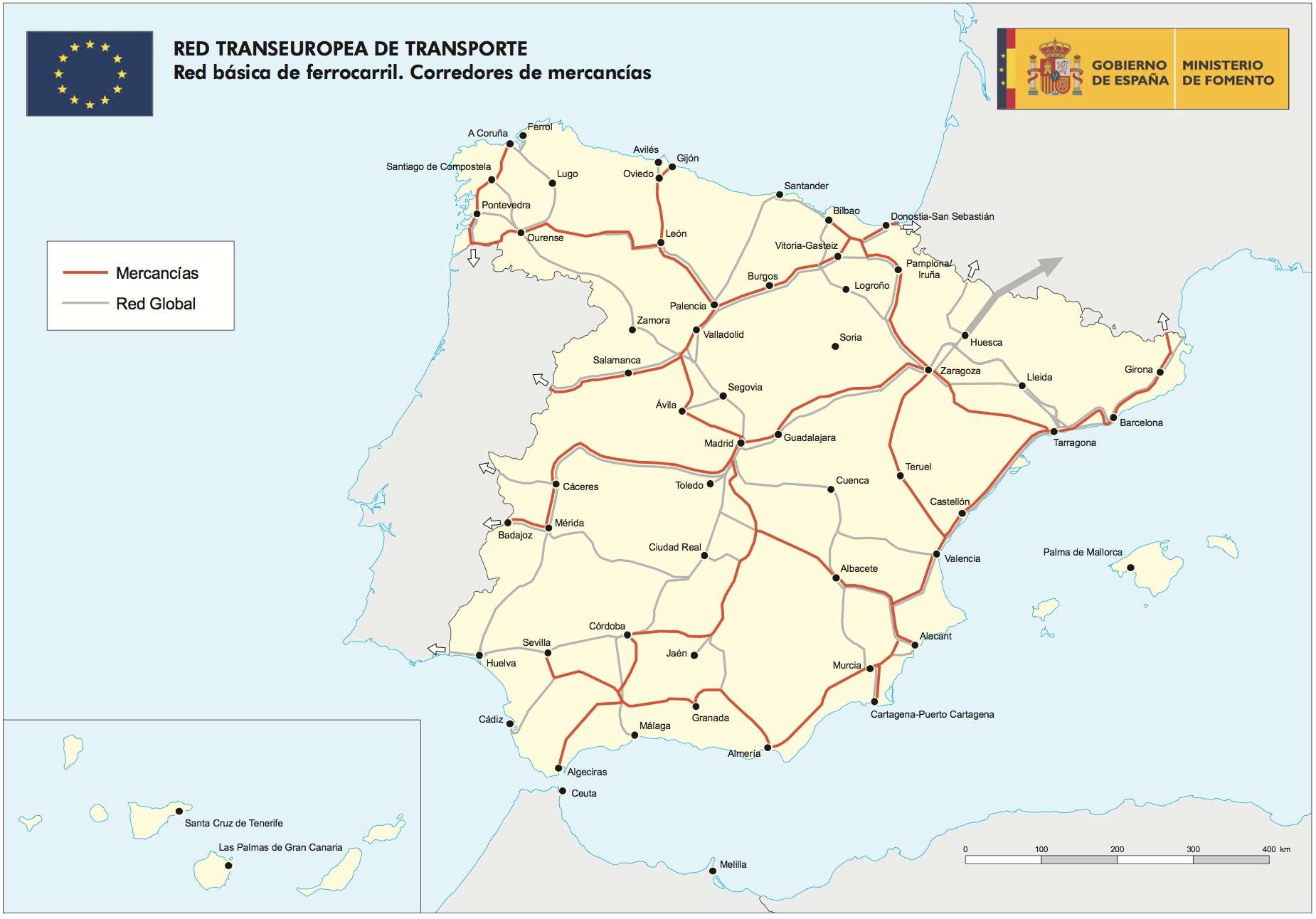
This map, shows the (planned) main routes from the Iberian peninsula into western Europe and helps to clear the confusion. There are others you can refer to here.
"Almería - Valencia/Madrid - Zaragoza/Barcelona - Marseille" presumably means that the plan includes two European gauge rail freight corridors:
a. Almería - Madrid - Zaragoza - Marseille...
b. Almería - Valencia - Barcelona - Marseille...
The latter is the "Mediterranean corridor", long-demanded by all the Mediteranean ports, whose geostrategic position would allow them (and thus the peninsula as a whole) to compete with the ports of northern Europe (Antwerp, Hamburg, Tilbury...) for the lucrative Middle and Far Eastern trade market.
The oblique strokes would seemingly not make clear how the Zaragoza - Marseille connection is to be made. A quick look at the map of "initial freight corridors" suggests that the Barcelona route makes economic sense, without the need for investments beyond.
However, the map certainly does not clarify the Almería - Madrid route: one stretch of the track is not marked for freight.
Moreover, the footnote says that "routes 4 and 6 should in the future be completed by Project 16, the Sines/Algeciras-Madrid-Paris freight axis which takes in the central Pyrenees crossing via a low elevation tunnel". What is Route 4? Route 4 starts in Sines (Portugal) and takes two routes, - Lisbon/Leixões and - Elvas/Algeciras before linking up, on both routes, to Madrid - Medina del Campo/Bilbao/San Sebastian - Irun - Bordeaux - Paris/Le Havre/Metz.
What is Priority Project 16", then? It seems to be a longer term project, one of "30 Priority Projects (or axes)... identified on the basis of proposals from the Member States and are included in the Union guidelines for the development of the TEN-T as projects of European interest" (source)
This is the map of the enigmatic "Priority Project 16: Freight railway axis Sines/Algeciras-Madrid-Paris", not included as one of the "initial freight corridors" in the 2010 Regulation.

As far as one can see, this is basically the initial freight corridor No. 4, up to Madrid. And from Saragossa northwards, we again find that enigmatic route through the Central Pyrenees, marked as a grey line in the top map, and here in a strange arrow shape.
The Executive Agency's 2011 Progress Report on on-going projects (the most recent I have found) consists of a map, of which I have just taken the following:

Yet again, there is an enigmatic, but well drawn arrow shape or through across the central Pyrtenees. Moreover, the pink dot in the middle means that there is (or was) an on-going project in that area. WEhat is it? Well ,the previous map gave its reference number, which corresponds to "Freight Railway Axis Sines-Madrid-Paris: New high capacity line through the Pyrenees". We are informed on the Agency website that
"At a high level inter-governmental conference in Zaragoza, Spain in June 2008, France and Spain committed to launch the necessary studies for the construction of this new line through the creation of a European Economic Interest Group (EEIG).
This project specifically consists of the preparation of the following studies as:- Preliminary technical, economic and financial studies, including an analysis of the possible locations of the corridor in France and Spain
- Environmental studies
- Studies necessary to launch the public consultations in Spain and the public debate in France"
The Agency website tells us that "The project also includes the construction of a long distance tunnel through the Pyrenees, in order to eventually link it with the branch of the Grand Projet du Sud-Ouest [GPSO] towards Toulouse." However, the GPSO website speaks nowhere at all of any tunnel through the Pyrenees. Instead it says that "Le Grand Projet ferroviaire du Sud-Ouest fait partie du projet global LGV Sud Europe Atlantique (LGV SEA) défini, depuis la déclaration d'intention du 25 janvier 2007, comme un ensemble cohérent composé de trois branches : Tours-Bordeaux, Bordeaux-Toulouse et Bordeaux-Espagne, auquel a été ajoutée la branche Poitiers-Limoges."

Returning to the Agency website, we read that Priority Project 6 is the "Railway axis Lyon-Trieste-Divača/Koper-Divača-Ljubljana-Budapest-Ukrainian border" does not start in Almería or even in Spain: it takes off in Lyon.
The confusion grows when we read yesterday that
"Pastor firma en Bruselas un acuerdo que impulsará el transporte ferroviario de mercancías por el Corredor Mediterráneo
Con los responsables de transportes de Francia, Italia, Eslovenia y Hungría.
- El acuerdo establece la Comisión Ejecutiva del Corredor Ferroviario de Mercancías nº6, que se extenderá desde Almería hasta Zahony (Hungría)."
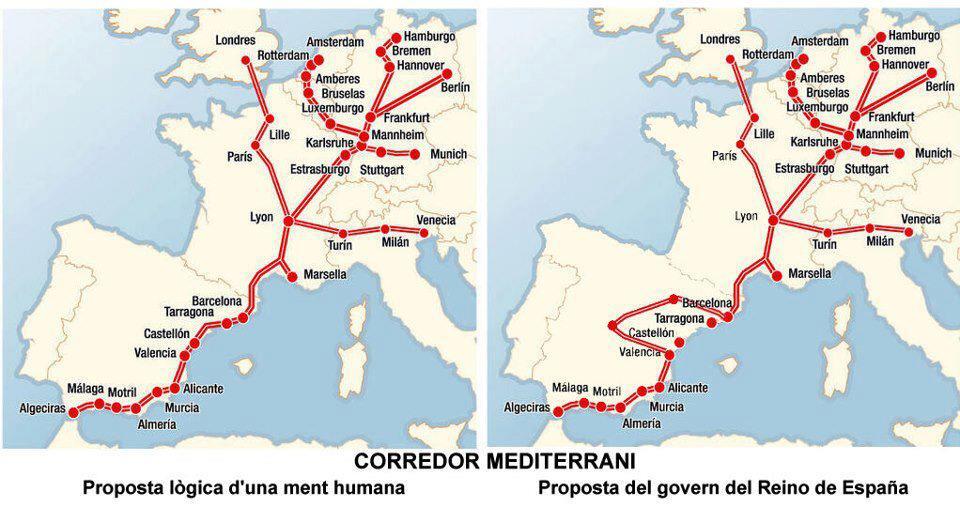
Today twitter is full of odd maps (like the one on the right, below) and many Catalans feel that the "Mediteranean" corridor Minister Pastor speaks of will in fact go through Madrid! A public clarification is in order!
4 de març 2013
The Treaty of Utrecht (1713) and the Siege of Barcelona (1713-1714)
Article 13 reads:
"Whereas the Queen of Great Britain has continually pressed and insisted with the greatest Earnestness, that all the Inhabitants of the Principality of Catalonia, of whatever State or Condition they may be, should not only obtain a full and perpetual Oblivion of all that was done in the late War, and enjoy the entire possession of all their Estates and Honours; but should also have their ancient Privileges preserved safe and untouched; the Katholic King, in compliance with the said Queen of Great Britain, hereby grats and confirms to all the Inhabitants of Catalonia whatsoever, not only the Amnesty desired, together with the full Possession of all their Estates and Honours; but also gives and grants to them, all the Privileges which the inhabitants of both Castiles, who of all the Spaniards are the most dear to the Catholick King, have and enjoy, or may hereafter have and enjoy".
This text was signed in Utrecht on July 13 1713. (source)
King Philip V of Spain (IV of Aragon) laid siege to the city of Barcelona on July 25 1713: twelve days later. The siege was to last 13 months, and ended with the fall of the city to the Spanish and French troops.
Britain's signature in the Treaty of Utrecht broke with its commitments in the earlier, secret Treaty of Genoa, signed between England (represented by Mr. Mitford Crow) and Catalonia ( represented by Antoni Peguera i Aymerich and Dr. Domènec Perera) in 1705. A Spanish version can be read here (pp. 43-47 of the book, pp. 99-103 of the PDF file). A Catalan translation is available here.
"Whereas the Queen of Great Britain has continually pressed and insisted with the greatest Earnestness, that all the Inhabitants of the Principality of Catalonia, of whatever State or Condition they may be, should not only obtain a full and perpetual Oblivion of all that was done in the late War, and enjoy the entire possession of all their Estates and Honours; but should also have their ancient Privileges preserved safe and untouched; the Katholic King, in compliance with the said Queen of Great Britain, hereby grats and confirms to all the Inhabitants of Catalonia whatsoever, not only the Amnesty desired, together with the full Possession of all their Estates and Honours; but also gives and grants to them, all the Privileges which the inhabitants of both Castiles, who of all the Spaniards are the most dear to the Catholick King, have and enjoy, or may hereafter have and enjoy".
This text was signed in Utrecht on July 13 1713. (source)
King Philip V of Spain (IV of Aragon) laid siege to the city of Barcelona on July 25 1713: twelve days later. The siege was to last 13 months, and ended with the fall of the city to the Spanish and French troops.
Britain's signature in the Treaty of Utrecht broke with its commitments in the earlier, secret Treaty of Genoa, signed between England (represented by Mr. Mitford Crow) and Catalonia ( represented by Antoni Peguera i Aymerich and Dr. Domènec Perera) in 1705. A Spanish version can be read here (pp. 43-47 of the book, pp. 99-103 of the PDF file). A Catalan translation is available here.
9 de gen. 2013
"La Masia:" A model for the U.S.? (CBS)
Bob Simon's report for CBS TV on the Barcelona football club (January 2013, 14m 40s)
See also: http://www.cbsnews.com/8301-504803_162-57562240-10391709/soccer-academy-la-masia-a-model-for-the-u.s./
See also: http://www.cbsnews.com/8301-504803_162-57562240-10391709/soccer-academy-la-masia-a-model-for-the-u.s./
12 de nov. 2012
Papers from the 5th EUNoM Symposium / Ponències del 5è Simposi EUNoM 14-15/5/2012
TIC, aprenentatge virtual i llengües. Vídeos i resums del V Simposi de la xarxa Eunom (2012).
Si cal, clica a sota, a "Més informació", per accedir a tota l'entrada
26 d’oct. 2012
Catalonia in the news lately!
23/10/2012 [FR]
http://www.eurotopics.net/fr/home/presseschau/archiv/results/archiv_article/ARTICLE113104-L-Europe-favorise-les-separatismes
L'Europe favorise les séparatismes
Les mouvements séparatistes en Espagne, Belgique et Grande-Bretagne ont des origines différentes, mais ils ont tous étés favorisés par l'intégration européenne, analyse le quotidien libéral NRC Handelsblad....
27/9/2012 [NL]
http://www.nrc.nl/nieuws/2012/09/27/catalonie-wil-referendum-over-zelfbeschikking-houden/
Catalonië wil referendum over zelfbeschikking houden

Catalaanse demonstranten bij een protest in Barcelona deze week. Foto Reuters / Gustau Nacarin
BUITENLAND
Het regionale parlement van Catalonië heeft ingestemd met een referendum over zelfbeschikking van de regio. De Spaanse regering heeft al gezegd een dergelijke volksraadpleging door het hoogste Spaanse hof tegen te zullen laten houden. Dat meldt persbureau AP. [MORE]
.
.
30 de set. 2012
Video in English on Catalonia's fiscal arrangements with Spain
Participants:
More information: http://www.stopespoli.cat
More information on Catalonia-Spain relations: see "Spain's Secret Conflict" http://miquelstrubell.blogspot.com/2011/06/spains-secret-conflict-video-39-min-45.html
- Prof. Clara Ponsatí (Director of the Institute for Economic Analysis; Barcelona Graduate School of Economics)
- Prof. Montserrat Guibernau (Professor of Politics at Queen Mary College University of London)
- Dr. Joan B. Casas (Dean of Catalan College of Economists; Managing partner of Faura-Casas Auditors-Consultors S.L.)
- Dr. Heribert Padrol (Head of the TaxArea Corps of State Finance Inspectorate)
- Prof. Núria Bosch (Professor of Economics at the University of Barcelona; Researcher at Barcelona Economics Institute)
- Dr. Elisenda Paluzie (Researcher at the Centre for the Economic Analysis of Social Policies; Dean of the Faculty of Economics and Business of the University of Barcelona)
- Prof. Jordi Galí (Director of the Centre for Research in International Economics)
- Prof. Carles Boix (Robbert Garret Professor of Politics & Public Affairs at Princeton University
- Prof. Guillem López Casasnovas (Professor of Applied Economics at Pompeu Fabra University
- Prof. Andreu Mas-Colell (Minister of Economy and Knowledge, Gvoernment of Catalonia; Professor of Economics at Pompeu Fabra University; former Professor of Economics at Harvard University (1981-1996)
Click to watch video Video in English (2m 54s): 
More information: http://www.stopespoli.cat
More information on Catalonia-Spain relations: see "Spain's Secret Conflict" http://miquelstrubell.blogspot.com/2011/06/spains-secret-conflict-video-39-min-45.html
26 de set. 2012
Relations between Catalonia and Spain: "Make them give back what they took away"
The latest entry by the last President of Extremadura, Guillermo Fernández Vara is titled "Give back what you took away!"
Que devuelvan lo que se llevaron
Sé que no es hora de salidas de pata de banco. Ni de regates en corto. Pero las palabras hoy del Presidente de la Generalitat, sus decisiones y las consecuencias de las mismas, no me permiten cruzarme de brazos, nos nos permiten cruzarnos de brazos. Mañana tendré la oportunidad de valorar en rueda de prensa la situación, pero quiero decir algo que no admite demoras. No sé que pasará, creo que ni el lo sabe, y bien grave que es someter en plena crisis a Cataluña y al resto de España, a unas elecciones con un programa electoral basado en la independencia, y no en el empleo, las empresas, la educación o la sanidad. Pero si algún día logrará su objetivo, el President debería devolver antes lo que se llevaron hace ahora treinta o cuarenta años. No me refiero a riquezas materiales sino a seres humanos. 150.000 personas que nos fueros sustraidas, más sus hijos y sus nietos. No digo más. Nacieron en España, en una parte de la misma llamada Extremadura, que no les podía dar de comer porque alguien así lo decidió. Y se fueron a otra parte de España, Cataluña, porque el mismo así lo decidió. Llegado el momento, por favor que antes nos los devuelvan.
Guillermo
http://www.elcuadernodeguillermo.com/?p=180057&cpage=1#comment-9000
"Make them give back what they took away"
I know it's not the time for to bench leg outputs. Or for short dribbles. But today the words of the President of the Generalitat, his choices and the consequences thereof, will not let me sit back with folded arms, won't let us sit back with folded arms. Tomorrow I will have the opportunity to assess the situation in a press conference, but I mean to say something that can't wait. I do not know what will happen, and I don't think even he knows, and it is quite serious in the throes of this crisis, to subject in Catalonia and the rest of Spain, to an election with a manifesto based on independence, and not on employment, business, education or health. But if someday he were to achieve his objective, the President should first return what they took away thirty or forty years. I do not mean material wealth but human beings. 150,000 people were taken from us, and their children and grandchildren. I've said enough. They were born in Spain, in a part of it called Extremadura, that could not feed them because someone decided. And they went to another part of Spain, Catalonia, because that same person decided. If and when the time comes, please return them to us beforehand.
Que devuelvan lo que se llevaron
Sé que no es hora de salidas de pata de banco. Ni de regates en corto. Pero las palabras hoy del Presidente de la Generalitat, sus decisiones y las consecuencias de las mismas, no me permiten cruzarme de brazos, nos nos permiten cruzarnos de brazos. Mañana tendré la oportunidad de valorar en rueda de prensa la situación, pero quiero decir algo que no admite demoras. No sé que pasará, creo que ni el lo sabe, y bien grave que es someter en plena crisis a Cataluña y al resto de España, a unas elecciones con un programa electoral basado en la independencia, y no en el empleo, las empresas, la educación o la sanidad. Pero si algún día logrará su objetivo, el President debería devolver antes lo que se llevaron hace ahora treinta o cuarenta años. No me refiero a riquezas materiales sino a seres humanos. 150.000 personas que nos fueros sustraidas, más sus hijos y sus nietos. No digo más. Nacieron en España, en una parte de la misma llamada Extremadura, que no les podía dar de comer porque alguien así lo decidió. Y se fueron a otra parte de España, Cataluña, porque el mismo así lo decidió. Llegado el momento, por favor que antes nos los devuelvan.
Guillermo
http://www.elcuadernodeguillermo.com/?p=180057&cpage=1#comment-9000
"Make them give back what they took away"
I know it's not the time for to bench leg outputs. Or for short dribbles. But today the words of the President of the Generalitat, his choices and the consequences thereof, will not let me sit back with folded arms, won't let us sit back with folded arms. Tomorrow I will have the opportunity to assess the situation in a press conference, but I mean to say something that can't wait. I do not know what will happen, and I don't think even he knows, and it is quite serious in the throes of this crisis, to subject in Catalonia and the rest of Spain, to an election with a manifesto based on independence, and not on employment, business, education or health. But if someday he were to achieve his objective, the President should first return what they took away thirty or forty years. I do not mean material wealth but human beings. 150,000 people were taken from us, and their children and grandchildren. I've said enough. They were born in Spain, in a part of it called Extremadura, that could not feed them because someone decided. And they went to another part of Spain, Catalonia, because that same person decided. If and when the time comes, please return them to us beforehand.
Note: Extremadura-born Catalan residents:
1981 184,592
1991 171,597
2001 152,097
27 d’ag. 2012
Current affairs in Catalonia (August 2012) Part 2
Financial Times: 'Spain Autonomy under Fire'. Summary here. 16 August 2012
Asia Times: Turning back to Napoleon. 9 August 2012
Terra Brasil: Catalão cria polêmica e diz que defende Espanha por falta de opção. 5 August 2012
O Globo. Crise na Espanha acirra movimentos separatistas. 4 August 2012
Irish Times. Regional wrangles. Traducció automàtica. 2 August 2012
The Daily Telegraph: 'Only Mario Draghi's ECB can avert global calamity before the year is out'. 29 July 2012
La Tribune.
Public Service Europe. Catalonia wants independence, not Spanish austerity. 23 July 2012.
The German Marshall Fund of the United States: As Spain Protests Austerity, Catalonia Pushes for Independence. 20 July 2012.
1 d’ag. 2012
Current Affairs in Catalonia (August 2012) Part 1
We recommend an article entitled "El Setge" ("The Siege") by La Vanguardia columnist Jordi Graupera. It was published on July 28th. This article should not be confused with the one written by Manel Cuyàs, with the same title, published in El Punt Avui on April 15th 2012: http://www.elpuntavui.cat/noticia/article/7-vista/8-articles/528207.html (see my English translation here: http://miquelstrubell.blogspot.com/2012/04/siege.html)
http://epaper.lavanguardia.com/epaper/mobile/articleview.aspx?bookmarkid=FDYH5JLG8QF7
El setge (The Siege)
Jordi Graupera
(our translation)
The immediate reactions of the Spanish parties to the fiscal pact adopted by the Catalan Parliament last Wednesday coul lead one to think that a period of political confrontation between Catalan and Spanish institution is about to begin. However, the truth is quite another: the conflict broke out some time ago and the Government in Madrid has been working for months on the basis of the most radical hypothesis, taking for granted that the "uncharted territory” that CiU says we are entering is a secessionist operation.
The most graphic way of describing the Spanish Government's maneouvres is to talk about the Catalan civil servants' payroll. The State – that claims to have guaranteed cashflow until December –, instead of paying the money it is bound to do, as a lump sum for Catalan minister Mas-Colell to administer, makes monthly payments, with which the Generalitat (Catalan Goveernment) pays the payroll. But these are not made on 25th, as would be logical were minister Montoro to have the intention of negotiating something, or of “cooperating”, as he puts it. He makes the payments on the 31st, at 11.30 pm.
If you want to talk to the top officials in the President's Office or the Catalan Minitry of Economy, I recommend that you phone at the end of the month, late at night: you'll be sure to find them, they're always there, just in case the cash doesn't arrive. That's if they're lucky. Last month it didn't, and the money wouldn't have arrived in time; the Catalan minister warned that the Government might default – in which case complete political intervention would have ensued –, and Cristóbal Montoro said fine, it's your problem, you solve it. A short-term loan from a Catalan bank allowed the month to be saved. And this month the payroll will be met by the annual tax on fortunes - a feature of the Catalan tax system –, but I've seen mayors rushing because they won't have enough money to pay for services they have contracted. Next month, noone knows yet.
This situation means that the Government lives drowned by urgency, rushing to and fro putting out fires. We have a full Harvard professor acting as accountant and a whole political generation buried by bureaucracy. Moreover, any audacious moviment by our political representatives is immediatately neutralised by the civil servants' payroll. Any default would mean that 250,000 people's salary would not be paid, and that the domino effect would shatter everything. And put any end to self-government. And this is just one example. There are plenty more: yes, the siege has begun.
The only relevant question, then, is whether the Catalan Government is doing anything so as not to have to rely so drastically upon the Madrid agenda, which consists of empoverishing the Catalan Government (Generalitat), firstly to have it under its control, and then without any maneouvring leeway to dig in its heels and negotiate. A social explosion in Barcelona would be perfect for centralizing once and for all, with the assent of the world, and the only way out for Artur Mas is to appeal to the people, through any early election, and on a clearly pro-independence ticket. Time, however, is on Madrid's side: for every month he has less room in which to manoeuvre.
See previous current affairs postings on this weblog: http://estudiscatalans.blogspot.com/2012/06/current-affairs-in-catalonia.html
http://epaper.lavanguardia.com/epaper/mobile/articleview.aspx?bookmarkid=FDYH5JLG8QF7
El setge (The Siege)
Jordi Graupera
(our translation)
The immediate reactions of the Spanish parties to the fiscal pact adopted by the Catalan Parliament last Wednesday coul lead one to think that a period of political confrontation between Catalan and Spanish institution is about to begin. However, the truth is quite another: the conflict broke out some time ago and the Government in Madrid has been working for months on the basis of the most radical hypothesis, taking for granted that the "uncharted territory” that CiU says we are entering is a secessionist operation.
The most graphic way of describing the Spanish Government's maneouvres is to talk about the Catalan civil servants' payroll. The State – that claims to have guaranteed cashflow until December –, instead of paying the money it is bound to do, as a lump sum for Catalan minister Mas-Colell to administer, makes monthly payments, with which the Generalitat (Catalan Goveernment) pays the payroll. But these are not made on 25th, as would be logical were minister Montoro to have the intention of negotiating something, or of “cooperating”, as he puts it. He makes the payments on the 31st, at 11.30 pm.
If you want to talk to the top officials in the President's Office or the Catalan Minitry of Economy, I recommend that you phone at the end of the month, late at night: you'll be sure to find them, they're always there, just in case the cash doesn't arrive. That's if they're lucky. Last month it didn't, and the money wouldn't have arrived in time; the Catalan minister warned that the Government might default – in which case complete political intervention would have ensued –, and Cristóbal Montoro said fine, it's your problem, you solve it. A short-term loan from a Catalan bank allowed the month to be saved. And this month the payroll will be met by the annual tax on fortunes - a feature of the Catalan tax system –, but I've seen mayors rushing because they won't have enough money to pay for services they have contracted. Next month, noone knows yet.
This situation means that the Government lives drowned by urgency, rushing to and fro putting out fires. We have a full Harvard professor acting as accountant and a whole political generation buried by bureaucracy. Moreover, any audacious moviment by our political representatives is immediatately neutralised by the civil servants' payroll. Any default would mean that 250,000 people's salary would not be paid, and that the domino effect would shatter everything. And put any end to self-government. And this is just one example. There are plenty more: yes, the siege has begun.
The only relevant question, then, is whether the Catalan Government is doing anything so as not to have to rely so drastically upon the Madrid agenda, which consists of empoverishing the Catalan Government (Generalitat), firstly to have it under its control, and then without any maneouvring leeway to dig in its heels and negotiate. A social explosion in Barcelona would be perfect for centralizing once and for all, with the assent of the world, and the only way out for Artur Mas is to appeal to the people, through any early election, and on a clearly pro-independence ticket. Time, however, is on Madrid's side: for every month he has less room in which to manoeuvre.
See previous current affairs postings on this weblog: http://estudiscatalans.blogspot.com/2012/06/current-affairs-in-catalonia.html
23 de jul. 2012
"As Spain Protests Austerity, Catalonia Pushes for Independence"
"According to recent polls, over half of Catalans would vote for independence from Spain. With widespread unemployment and expectations of long-term austerity, Brussels and Washington should watch Spain carefully..." (click here to read the rest)
Posted July 20, 2012 by Nicholas S. Siegel, the Program Officer at the Transatlantic Academy, where he helps design and implement Academy research activities and outreach strategies. His research focuses on the US-EU.
The Transatlantic Academy is a research institution devoted to creating common approaches to the long-term challenges facing Europe and North America. The Academy does this by each year bringing together scholars, policy experts, and authors from both sides of the Atlantic and from different disciplinary perspectives (click here to read more)
Posted July 20, 2012 by Nicholas S. Siegel, the Program Officer at the Transatlantic Academy, where he helps design and implement Academy research activities and outreach strategies. His research focuses on the US-EU.
The Transatlantic Academy is a research institution devoted to creating common approaches to the long-term challenges facing Europe and North America. The Academy does this by each year bringing together scholars, policy experts, and authors from both sides of the Atlantic and from different disciplinary perspectives (click here to read more)
17 de jul. 2012
Twitter conflict
Just like any other environment where people of all sorts meet and jostle together, Twitter allows us all to let us off steam!
The fact that some people in Spain view Catalan and Catalans critically is easy to observe and study.
The development and publication on July 8th of a Catalan-language interface for PC access to http://www.twitter.com/ gave rise to reactions of all kinds. On July 12 Global Voices printed a report by Violeta Camarasa, with juicy comments translated into English.
#twitterencatala provokes tweets of joy and hate

A website that records anti-Catalan tweets, in Spanish, is http://apuntem.cat/

The fact that some people in Spain view Catalan and Catalans critically is easy to observe and study.
The development and publication on July 8th of a Catalan-language interface for PC access to http://www.twitter.com/ gave rise to reactions of all kinds. On July 12 Global Voices printed a report by Violeta Camarasa, with juicy comments translated into English.
#twitterencatala provokes tweets of joy and hate
A website that records anti-Catalan tweets, in Spanish, is http://apuntem.cat/
A Catalan MEP, Ramon Tremosa, has complained to the European Commission about these anti-Catalan ethnic tweets, which have not been as yet percecuted by the authorities. There are precedents in other countries. UK Student Liam Stacey was sentenced to 56 days in prison in March 2012 for posting offensive comments on Twitter after footballer Fabrice Muamba had a cardiac arrest during a match:
Subscriure's a:
Missatges (Atom)